Here are just a few of Shotover's ancient trees, recorded as part of the Shotover Ancient Trees Project.
~~~~~~~~~~~~~~~~~~~~~~~~~~~~~~~~~~~~~~~~~~
The Claw Oak
Species: Quercus robur, English Oak
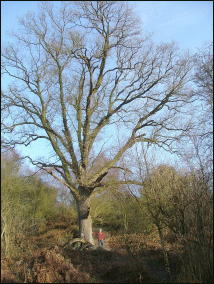
This fine specimen of an oak stands tall above the scrub, just off the beaten track near the heart of Shotover Country Park. Known as the Claw Oak due to the three-pronged, claw-like dead branch that lies at its foot (having fallen out of the tree’s spreading crown a few years ago), this is understood to be a “maiden” tree, i.e. one that has been allowed to grow up without alteration by the process of pollarding, in contrast to the nearby, well-known Shotover Oak.
Dead wood (such as the “claw” underneath this specimen) can be a tremendously important resource for all manner of insects, fungi and other wildlife. As constant suppliers of dead wood, old trees are thus a valuable component of woodland eco-systems and are now recognised as a conservation priority locally and across the UK.
The heavy use of the adjacent footpath (especially by mountain bikers) has resulted in the severe compaction of the soil and the tree roots. Shotover Wildlife has constructed a sturdy barrier of large logs and branches and created an alternative route that will relieve the pressure and help protect the roots thus prolonging the longevity of the tree.
~~~~~~~~~~~~~~~~~~~~~~~~~~~~~~~~~~~~~~~~~~
Dick's Crab
Species: Malus species, Crab Apple
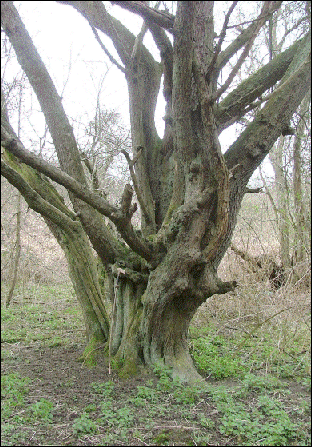
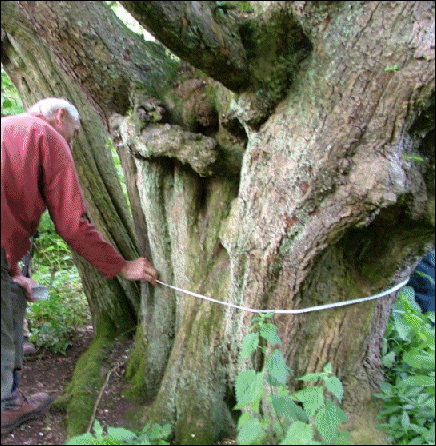
The significance of this Crab Apple tree, which can be found just downhill of the Claw Oak, was first pointed out to the project by Dick Greenaway MBE, a woodland archaeologist who grew up locally.
With an estimated age of around 150 years and a girth of 9 feet 8 inches, this is a particularly large specimen for its species and has therefore taken a well-earned place within our tree inventory.
Each autumn, crab trees produce an abundance of crab apples, which are sharper to taste than closely-related domestic apples. Because crabs can retain their fruit longer than many other trees, they can be a useful resource for birds. Shotover Wildlife members have made Crab Apple Jelly from its fruit - a delicious 150 year old flavour!
~~~~~~~~~~~~~~~~~~~~~~~~~~~~~~~~~~~~~~~~~~
The Four Old Men
Species: Betula pubescens, Downy Birch
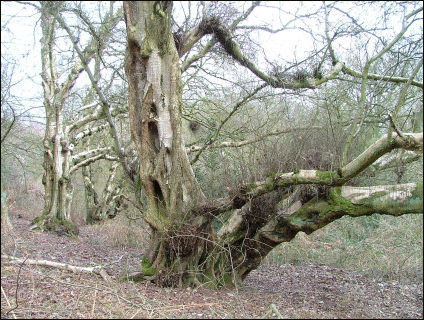
The Four Old Men are a set of particularly fine old Downy Birches, found on Horspath Common near the edge of Shotover Country Park. Whilst old birches can be found across the park, these specimens are notable for their especially gnarled appearance and butressed trunks. Added interest is provided by a variety of mosses and other small plants that grow on their trunks and branches.
Although small, mosses and liverworts are an important part of the ecosystems in which they grow, and can be home to an array of microscopic animals, so a well-mossed tree can be regarded as an important habitat in its own right.
Jacqueline Wright is a local bryologist (moss and liverwort specialist) who clambered up a ladder to investigate the minute plants growing on the “Four Old Men”.
The following are some of the species she found:
Old Man - Number 1
- Brachythecium velutinum - rough stalked feather moss
- Dicranoweisia cirrata - common pincushion
- Hypnum cupressiforme - cypress leaved plait moss
- Hypnum resupinatum - supine plait moss
- Kindbergia praelonga - common feather moss
- Lophocolea heterophylla (liverwort) - variable crestwort
- Orthotrichum affine - wood bristle moss
- Orthotrichum diaphanum - white tipped bristle moss
- Ulota crispa - crisped pincushion
Old Man - Number 2
- Bryum capillare - capillary thread moss
- Dicranoweisia cirrata - common pincushion
- Hypnum cupressiforme - cypress leaved plait moss
- Kindbergia praelonga - common feather moss
- Lophocolea heterophylla (liverwort) - variable crestwort
- Orthotrichum affine - wood bristle moss
- Rhynchostegium confertum - clustered feather moss
Old Man - Number 3
- Brachythecium rutabulum – rough-stalked feather-moss
- Hypnum cupressiforme - cypress leaved plait moss
- Kindbergia praelonga - common feather moss
Old Man - Number 4
Aulacomnium androgynum - bud headed groove moss
Cephalozia bicuspidata (liverwort) - two horned pincerwort
Dicranoweisia cirrata - common pincushion
Hypnum cupressiforme - cypress leaved plait moss
Hypnum resupinatum - supine plait moss
Kindbergia praelonga - common feather moss
Lophocolea bidentata (liverwort) bifid crestwort
Lophocolea heterophylla (liverwort) - variable crestwort
Orthotrichum affine - wood bristle moss
Orthotrichum diaphanum - white tipped bristle moss
~~~~~~~~~~~~~~~~~~~~~~~~~~~~~~~~~~~~~~~~~~
The Shotover Oak
Species: Quercus robur, English Oak
 The Tree
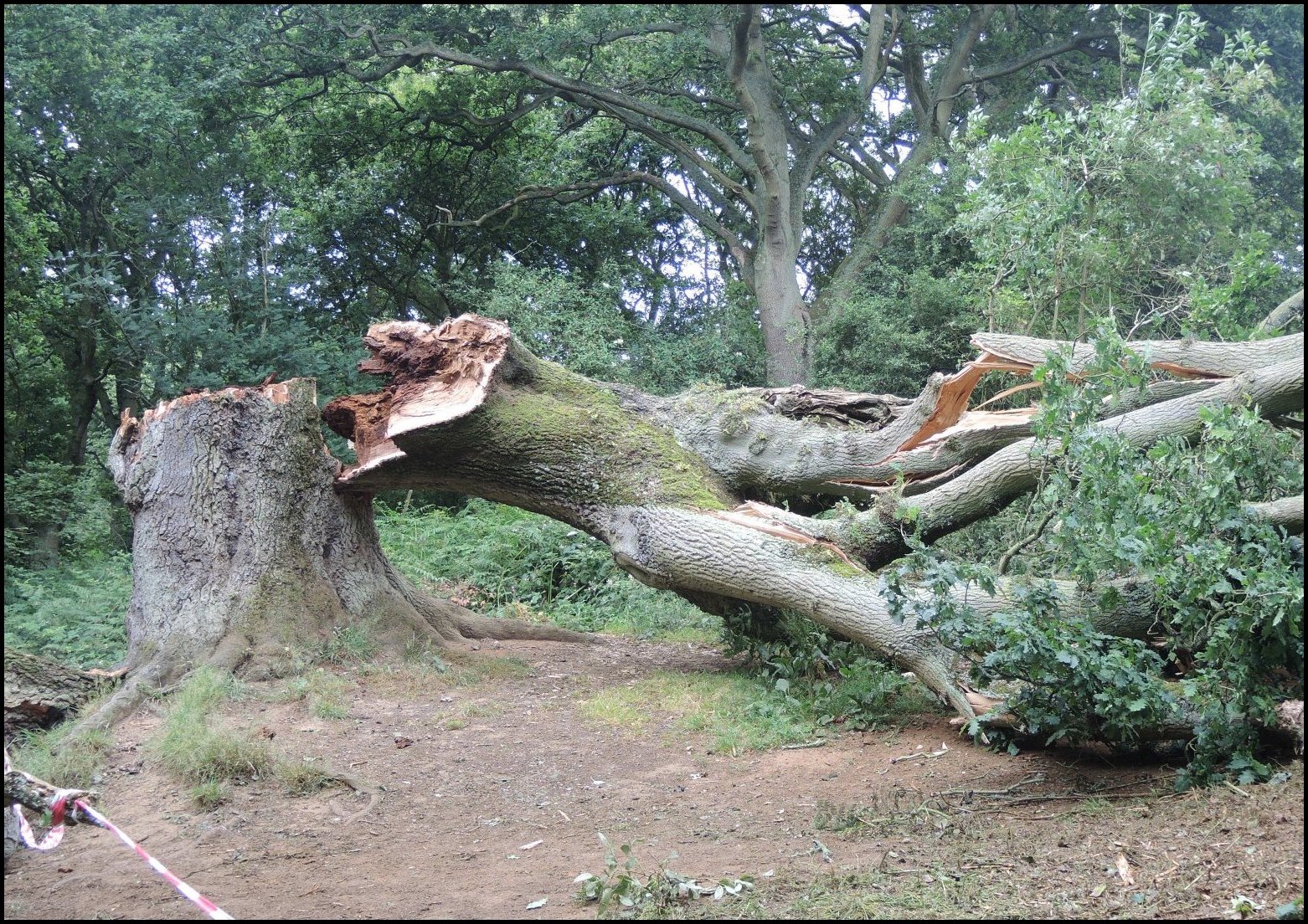
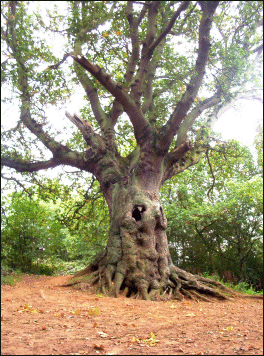
The Shotover Oak was one of the most iconic and much-loved trees on the Hill.
Its age can only be estimated, but calculations based on the best advice place it
between 410 and 450 years. This suggests that the acorn of this mighty oak germinated
in Tudor times, in the reign of Queen Elizabeth I; in fact not long after she travelled
over Shotover in 1566.
The Collapse
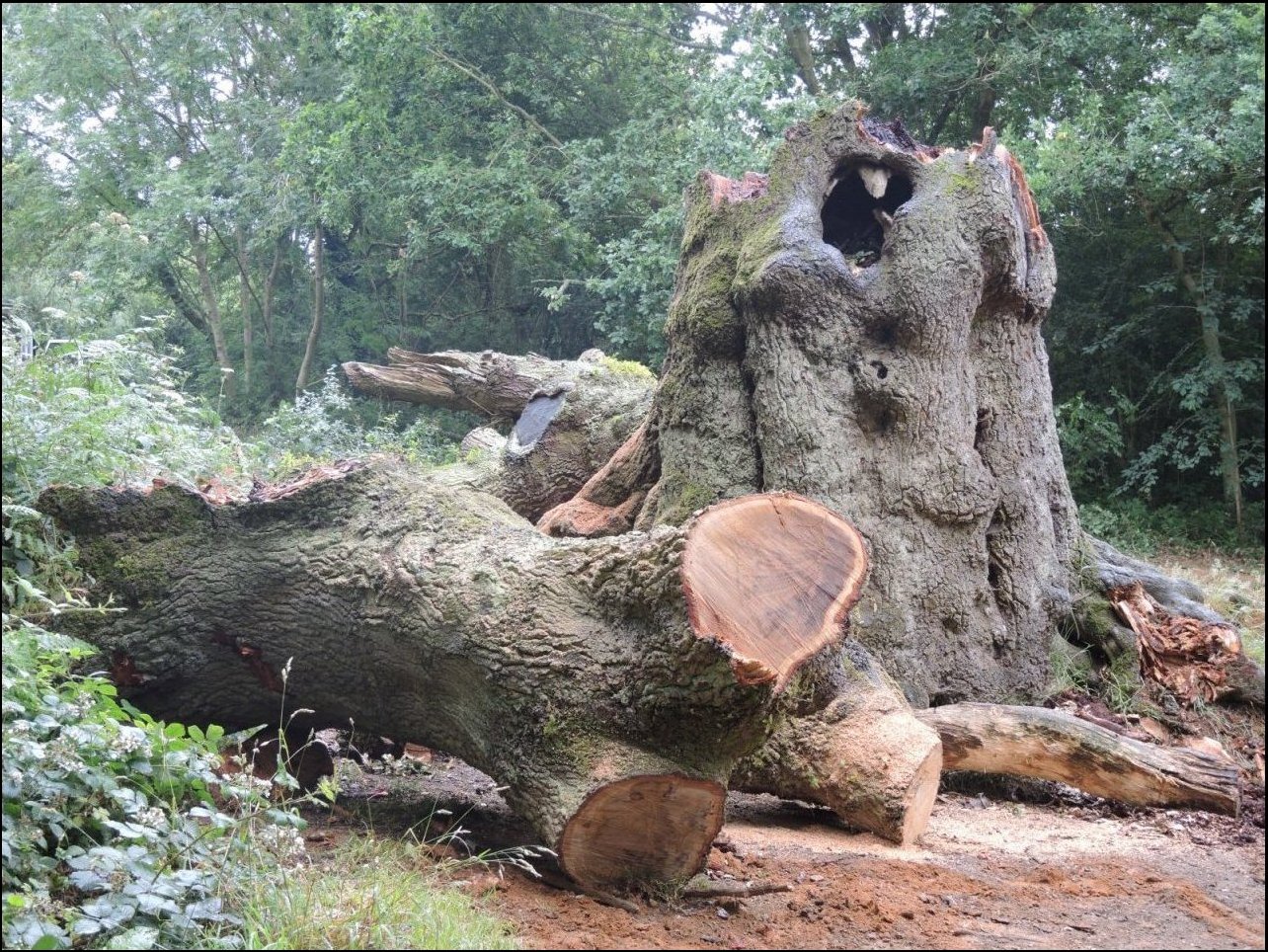
This cherished tree split and fell on 13th July 2015. The cause of the collapse was most
likely to be a combination of hollowing in the trunk and lower branches and the stress of
drought.
At least twice in past centuries The Shotover Oak had its upper boughs removed (pollarded – probably for the timber) which gave the tree its heavily branched appearance. Regular pollarding generally prolongs the life of a tree, but in time, can leave a weaker shape and with more places for rot to develop. So although the Shotover Oak had been growing healthily, the new timber added each year was not enough to offset hollowing at the top of the trunk and the two huge lower boughs fell away.
The weather had also been very dry in the weeks preceding the collapse. At times of drought an oak can become more brittle and then when rain arrives the additional weight of wet leaves (not wind) can be too much for some branches. 'Summer branch drop’ is a well-known phenomenon and probably accounts for many fallen branches.
The recovery
Advice from the Ancient Tree Forum (part of the Woodland Trust) suggested that any shoots that begin to grow at the base of the stump should be protected and in time, and with luck, a natural successor may become established. On inspection we found a good number of live shoots, and on raising this point with the City Council, a chestnut paling fence was erected – promptly and efficiently – to safeguard any developing buds. The hope is that the shoots will now be protected from rabbits, deer and clambering children, with the added bonus of protecting the hollow trunk as an important dead wood habitat.
~~~~~~~~~~~~~~~~~~~~~~~~~~~~~~~~~~~~~~~~~~
The Venerable Cherry
Species: Prunus avium, Wild Cherry
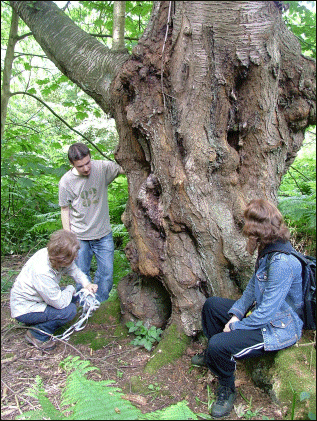
The national experts reckon that this charming tree may be amongst the most important Wild Cherry specimens in the country. This species is known for its profuse displays of white blossom each spring, which give way in summer to juicy fruit, which birds love to eat.
The tree has been noted to exude a great deal of resin each autumn: the thick, sticky, honey-coloured substance that, when fossilised, creates the Amber that is sometimes seen in unusual jewellery pieces (and which was made famous by “Jurassic Park”…) Look out for tiny little insects that might get stuck in this gooey mess: they may end up being preserved (dead, but perfectly formed) for millions of years!
~~~~~~~~~~~~~~~~~~~~~~~~~~~~~~~~~~~~~~~~~~